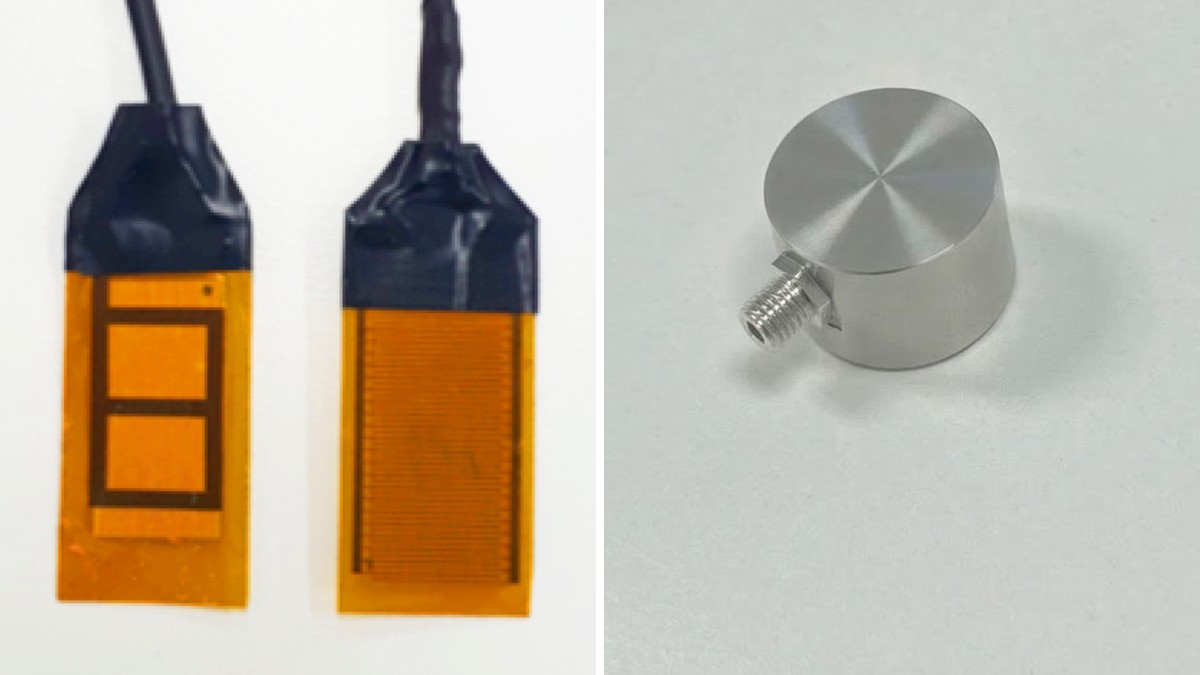
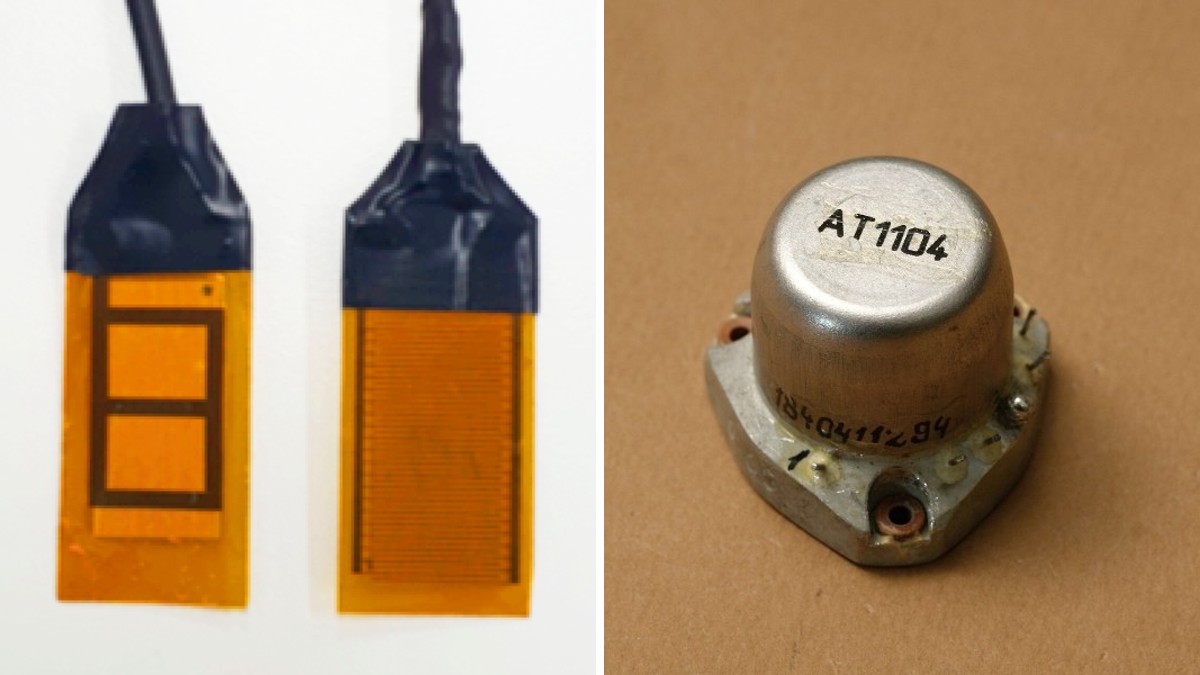
- AE sensors are divided into resonant and broadband types by frequency response, and into rigid housed and flexible types by form.
- Resonant sensors are highly sensitive at a specific frequency, making them suitable for continuous monitoring that detects whether an anomaly has occurred.
- Broadband sensors have even sensitivity over a wide band, making them suitable for waveform and frequency analysis and for distinguishing sources.
- Flexible sensors are thin and bendable, so they can be mounted tightly on curved surfaces such as pipes and in confined spaces.
AE sensors come in several types depending on their frequency response and form. This article explains the structure, characteristics and suitable applications of the resonant, broadband and flexible AE sensors most commonly used in industry.
How are AE sensors classified?
AE sensor types are distinguished by two criteria. One is which frequencies the sensor responds to and how strongly (frequency response); the other is what shape the sensor has (form). Resonant and broadband are classifications by frequency response, while flexible is a classification by form.
| Criterion | Types | How they differ |
|---|---|---|
| Frequency response | Resonant / broadband | Whether it responds strongly only at a specific frequency or evenly over a wide band |
| Form | Housed / flexible | Whether it is a rigid cylinder in a metal case or a thin, bendable film or patch |
Resonant AE sensors
In a resonant sensor, the internal piezoelectric element is designed to vibrate strongly at a specific frequency — the resonant frequency. Near the resonant frequency even small signals produce a large output, so sensitivity is high. Sensors with a resonant frequency around 150 kHz are widely used to monitor metal structures and piping, and sensors with lower or higher resonant frequencies are chosen depending on monitoring distance and target.
- Advantages: High sensitivity makes weak signals easy to capture, and sensors can be spaced farther apart under the same conditions. Their simple design makes them common for continuous monitoring.
- Limitations: The sensor’s resonance is strongly reflected in the output, making it difficult to analyze the frequency characteristics of the source itself.
- Suitable for: Continuous monitoring that detects anomalies such as leaks or cracks and sends alerts
Broadband AE sensors
A broadband sensor contains damping material that suppresses resonance, giving relatively even sensitivity over a wide range of roughly 100 kHz to 1 MHz. Because it does not amplify any particular frequency, the original frequency characteristics produced by the source are better preserved in the output.
- Advantages: Waveforms and spectra are obtained without distortion, which is advantageous for FFT analysis, source discrimination and collecting data for AI training.
- Limitations: Lower sensitivity than resonant sensors means closer sensor spacing, and noise management in the preamp and wiring becomes more important.
- Suitable for: Distinguishing sources such as cracks, friction and leaks, testing and research, and equipment requiring precise analysis
Flexible AE sensors
A flexible sensor uses polymer piezoelectric materials or composites instead of a rigid ceramic element and metal case, making it thin and bendable. Because it conforms to the surface curvature, it reduces the poor contact and signal loss that occur when a cylindrical sensor is mounted on a curved surface.
- Advantages: Can be mounted tightly on curved surfaces such as pipes, vessels and motor housings, and its thinness allows installation in confined spaces or between other components. Its light weight has little effect on the monitored structure.
- Considerations: Operating temperature ranges differ by material, so check the specifications for high-temperature equipment. Sensitivity characteristics differ from a ceramic sensor of the same area, so signals should be verified on the target.
- Suitable for: Curved pipes and pressure vessels, rotating machinery with limited installation space, and monitoring with sensors at many points
Because “flexible” is a classification by form, its frequency response can be closer to resonant or broadband depending on material and design. When choosing a sensor, it is more accurate to check form and frequency response separately.
Rina Solution’s FlexMate is a flexible AE sensor made from polymer materials and composites. It is attached to curved areas such as pipes to continuously monitor signals from cracks, damage and leaks.
The three sensor types at a glance
| Item | Resonant | Broadband | Flexible |
|---|---|---|---|
| Criterion | Frequency response | Frequency response | Form |
| Sensitivity | High near the resonant frequency | Relatively low | Depends on material and design |
| Frequency response | Concentrated in a specific band | Even over a wide band | Depends on design |
| Mounting surface | Best on flat surfaces | Best on flat surfaces | Curved surfaces and tight spaces |
| Main use | Anomaly detection · continuous monitoring | Source analysis · testing | Continuous monitoring of curved equipment |
Which sensor should you choose?
The sensor type is chosen by considering both the measurement purpose and installation conditions.
- If you want to know quickly whether something is wrong: a highly sensitive resonant sensor
- If you need to identify what caused the signal: a broadband sensor that preserves frequency characteristics
- If the surface is curved or space is tight: a flexible sensor that conforms to the surface
In the field, rather than using only one type, a common approach is to monitor continuously with resonant or flexible sensors and add broadband sensors for further analysis where abnormal signals appear. Selection criteria beyond the frequency band — installation environment, number of sensors and data processing — are covered in the AE sensor selection guide.
Wondering which AE sensor fits your equipment?
Tell us about your equipment and installation conditions, and we will propose a suitable sensor configuration and monitoring approach.
Contact usGet the company profile