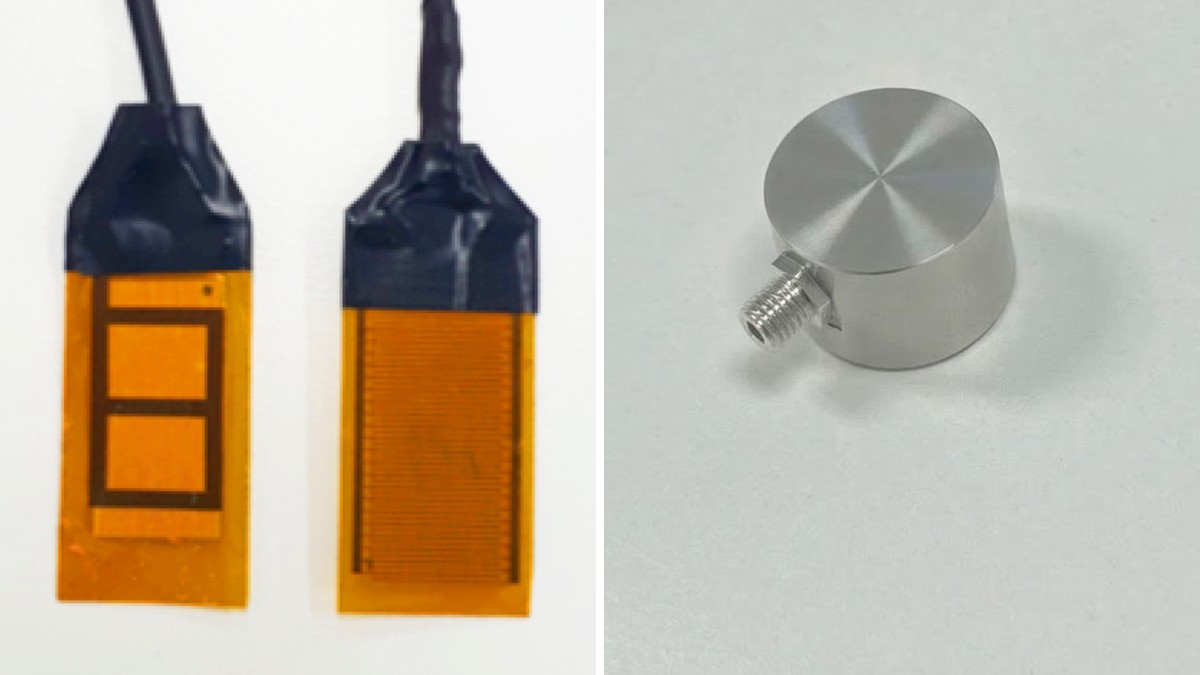
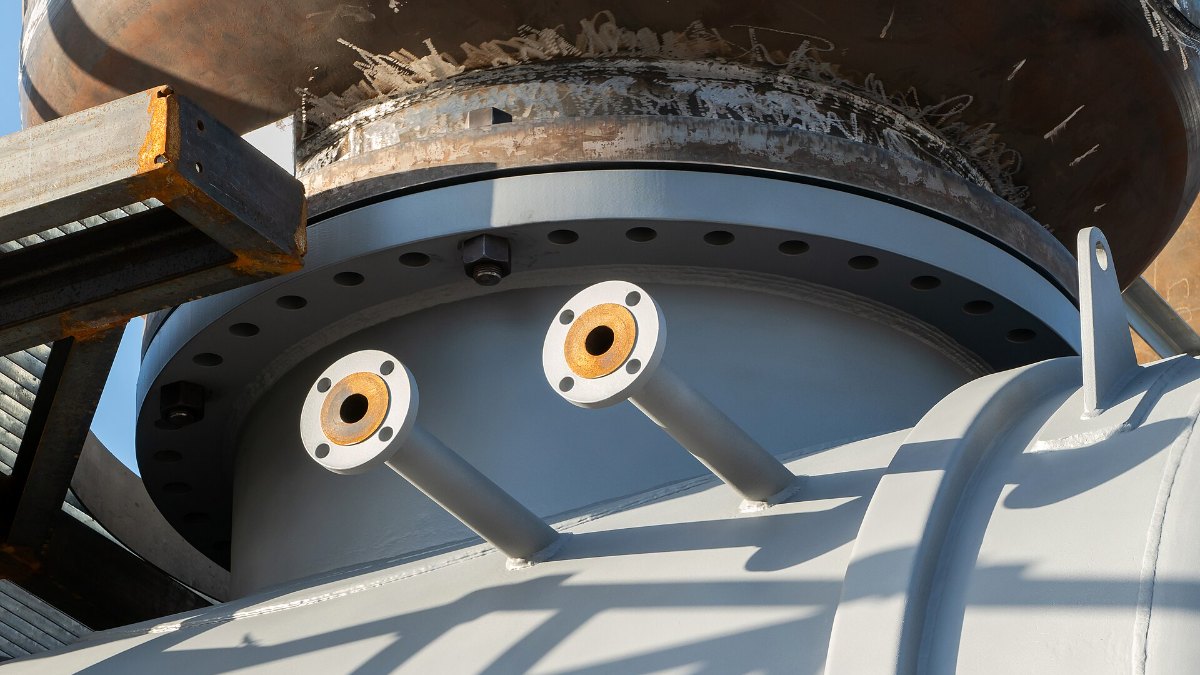
- Vibration sensors measure mechanical vibration from a few Hz to several tens of kHz; AE sensors capture high-frequency elastic waves from several tens of kHz to about 1 MHz.
- Multiple studies report that AE detected bearing and gear defects earlier than vibration.
- The two sensors are complementary, not substitutes. AE is strong at early signs; vibration is strong at tracking progression and finding the cause.
AE sensors and vibration sensors are both used for condition monitoring, but they measure different things and detect faults at different times. This article explains the differences and how to use them together.
They measure different things
A vibration sensor (accelerometer) measures phenomena that shake the whole machine, such as rotor imbalance, shaft misalignment and looseness. An AE sensor, by contrast, detects the high-frequency elastic waves released momentarily when a crack grows inside a material, when microscopic contact surfaces scrape, or when fluid escapes.
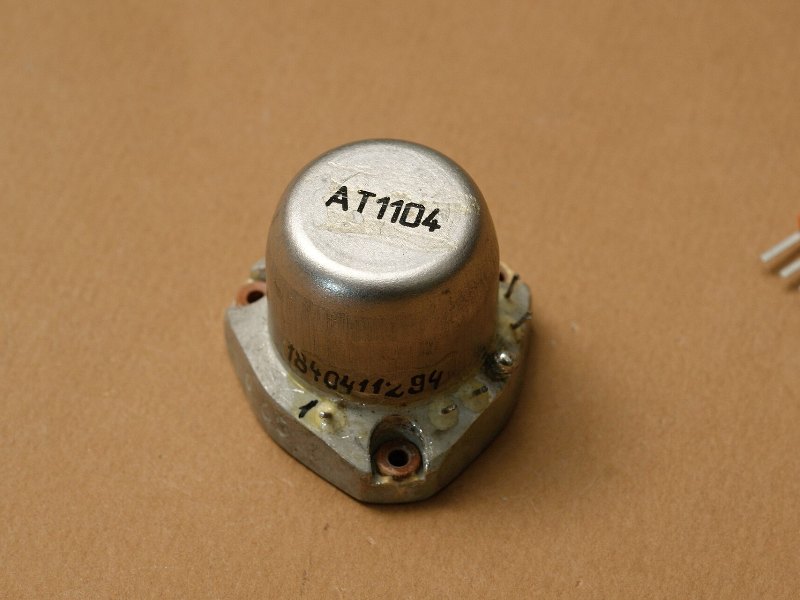
In short, a vibration sensor shows how the machine moves, while an AE sensor shows what is happening inside the material.
Most of the mechanical noise and vibration generated during operation is concentrated at low frequencies. Because AE sensors look at a much higher band, it is relatively easy to separate early defect signals even at sites with strong background vibration.
Why does AE detect faults earlier?
It is easiest to understand by looking at how a defect develops. First a micro-crack forms below the material surface, then it grows into surface damage, and only once the damage is large enough does the vibration pattern of the whole machine change. A vibration sensor responds from the last stage, but an AE sensor can pick up the signals produced by micro-cracks in the first stage.
Research on detection timing
- Bearing outer-race defects: In experiments with seeded defects of different sizes, AE detected the defects earlier than vibration analysis and could also track changes in defect size.[1]
- Planetary gearbox bearings: Even in planetary gear structures with complex transmission paths, AE identified defects earlier than vibration.[2]
- Fatigue damage in thrust ball bearings: In fatigue tests, AE detected initial cracks earlier than vibration, and the frequency content differed across the running-in, crack initiation, propagation and spalling stages.[3]
- Wind turbine roller bearings: Surface damage was detected ahead of vibration-based systems, with significant changes in the AE signal appearing well before the end of the test.[4]
Side-by-side comparison
| Item | AE sensor | Vibration sensor |
|---|---|---|
| Measures | Elastic waves from cracks, friction and leaks inside the material | Mechanical vibration of the machine |
| Frequency | Tens of kHz – about 1 MHz | A few Hz – tens of kHz |
| Detection timing | Early (micro-crack stage) | After damage has progressed to some extent |
| Good at | Micro-cracks, poor lubrication, leaks, defects in slow-speed machinery | Imbalance, misalignment, looseness, resonance |
| Data | High sampling rate, large data volume | Relatively small, with standardized analysis methods |
| Challenges | Requires noise separation and signal interpretation expertise | Insensitive to early-stage defects |
Most effective when used together
On site, it is more effective to divide roles than to choose one. AE catches early warning signs so inspections can be brought forward, and vibration data narrows down the cause — imbalance or bearing damage. Adding AE is especially effective for the following equipment.
- Slow-speed machinery: At low rotational speed, defect impacts carry little energy and are hard to catch with vibration alone.
- Gears and bearings with repeated failures: Early damage can be confirmed before the replacement cycle.
- Lines with strong background vibration: AE does not overlap with low-frequency machine vibration, so separation is easy.
- Pipes and vessels: Leaks and cracks are hardly detectable with vibration sensors.
Because AE is highly sensitive, it produces a lot of data and is affected by site noise. Installing sensors alone is not enough to make decisions, so check that the solution includes noise filtering, feature extraction and anomaly decision algorithms.
Want to add AE to your existing vibration monitoring?
We will recommend an AE sensor configuration suited to your equipment and how to combine it with vibration data.
Contact usView use cases[1] Al-Ghamd, A. M., & Mba, D. (2006). A comparative experimental study on the use of acoustic emission and vibration analysis for bearing defect identification and estimation of defect size. Mechanical Systems and Signal Processing, 20(7), 1537–1571.
[2] Elasha, F., Greaves, M., Mba, D., & Fang, D. (2017). A comparative study of the effectiveness of vibration and acoustic emission in diagnosing a defective bearing in a planetary gearbox. Applied Acoustics, 115, 181–195.
[3] Hase, A. (2020). Early Detection and Identification of Fatigue Damage in Thrust Ball Bearings by an Acoustic Emission Technique. Lubricants, 8(3), 37.
[4] Cornel, D., Gutiérrez Guzmán, F., Jacobs, G., & Neumann, S. (2021). Condition monitoring of roller bearings using acoustic emission. Wind Energy Science, 6, 367–376.